Start with the movement, then the appearance
A sliding shower door moves along the enclosure rather than swinging across the bathroom. A hinged door turns at an edge; a pivot door turns around a pivot position that may sit in from that edge. Folding or infold designs fold panels towards one another. Those movements change where you need free space.
Mark the basin, toilet, towel rail and the place where someone will stand to open the shower. Add the bathroom entrance door. A door that clears the basin in a drawing may still be awkward if the user has to squeeze between the basin and moving glass.
Compare the usable opening
Ask for the manufacturer’s clear-entry dimension for the exact size and configuration. A product called a 1200 mm sliding door does not give a 1200 mm opening: fixed glass and overlapping panels occupy part of the width. Do not estimate entry width from a photograph.
This comparison is a starting point, not a specification for a particular model. A showroom trial is especially useful where grip, balance or reaching around a door matters.
| Movement | Space to check | Question for the exact product |
|---|---|---|
| Sliding | Standing area and access to tracks | What clear entry remains when fully open? |
| Hinged | Full swing including the handle | Which way can it open? |
| Pivot | Both sides of the pivot | How much projects inward and outward? |
| Folding / infold | Folded panels and standing space | Can I enter without stepping around the folded glass? |
Try a complete routine
From outside, open the door, step through safely, imagine reaching the controls, then close it. Repeat the movement to leave and reach a towel. If a display is available, ask permission before using it and keep the trial dry. Do not treat a display as a grab support.
Think about cleaning too. Can you reach the overlap, lower seals and corners without awkward stretching? Ask which parts are intended to release for cleaning and where the instructions are. Compare glass care if that task is a priority.
Leave with two drawings and an unresolved list
Keep a sketch for each serious option, with movement and clear-entry dimension labelled. Write down unknowns rather than choosing whichever drawing looks least cluttered. For a curved enclosure, continue with the quadrant pairing checks.
Before ordering, have the finished opening checked against the adjustment range. Bring the sketches to an Isleworth showroom appointment, and ask ahead whether the particular door type is on display.
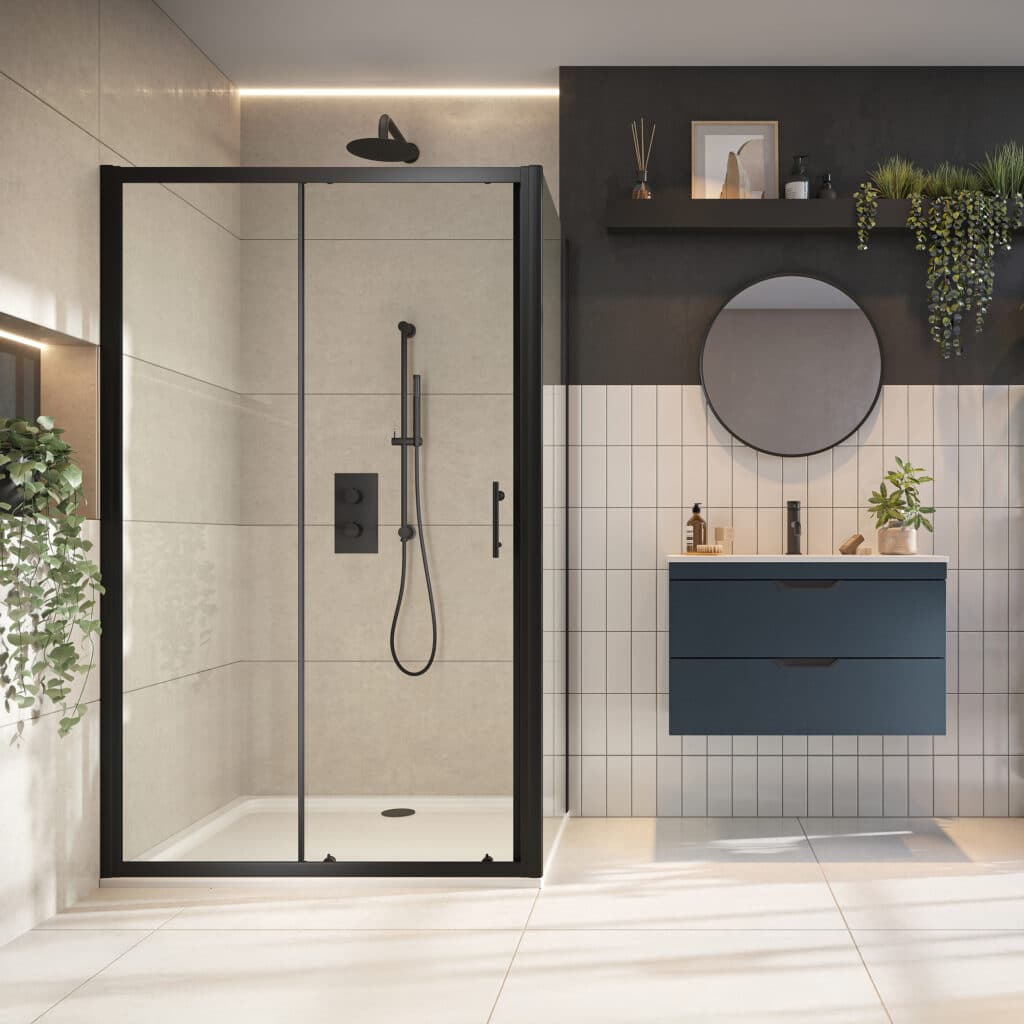
The pictured supplier example is S6 Black Sliding Door 1200. Use its exact specification when comparing options; the image does not confirm stock, showroom display availability or suitability for your room.
Sources & further reading
Prepared with AI assistance from the linked sources and Elegant Haven’s published service information. This guide helps you prepare decisions; product suitability and installation details need confirmation for your own room. It is not a record of a completed Elegant Haven installation or an expert sign-off.