Follow the route from overflow to waste
An overflow opening in the basin leads water through a passage towards the waste assembly. Slots in the appropriate waste allow that passage to communicate with the drain. Crosswater’s guidance distinguishes this from an unslotted waste intended for a basin without an overflow.
Confirm the exact basin design rather than judging by a photograph of its front face. Some product descriptions use convertible or universal terminology; obtain the configuration instructions and written compatibility for the selected pair.
Separate compatibility from the way the plug works
Clicker, push-button and pop-up descriptions concern how the user opens or closes the waste. They do not by themselves say whether it is slotted. Similarly, a chrome finish or a matching tap collection does not prove the waste fits the basin.
Ask whether a waste included with a tap is appropriate for your chosen basin. An inclusion can be useful, but it should not remove the compatibility question.
| Item to record | Question |
|---|---|
| Basin model | Does it have an overflow, and what does its maker specify? |
| Waste model | Slotted, unslotted or a documented convertible design? |
| Operation | How will the user open and close it? |
| Connections | What fittings and trap arrangement are required? |
| Furniture space | Does the intended arrangement fit the vanity design? |
| Quote | Included with the tap, supplied separately or still unconfirmed? |
Check the space beneath the basin
Review the proposed trap and connections with the installer, especially where drawers or shallow furniture occupy the same space. The visible waste cover is only part of the arrangement. A different basin or vanity can change the available room below.
Keep the basin, waste and furniture drawings together. The tap-hole checklist helps identify what is included with the brassware, while the tap pairing sketch checks the use area above it.
Keep the product details for routine care
Ask which parts the user is intended to remove for cleaning and follow that model’s instructions. Do not assume all clicker mechanisms dismantle the same way. Keep the waste code with the basin paperwork so a future replacement is identifiable.
Bring the completed pairing table to the showroom. Treat persistent slow drainage or leaks as a reason for appropriate assessment, not evidence that changing from slotted to unslotted is a suitable remedy.
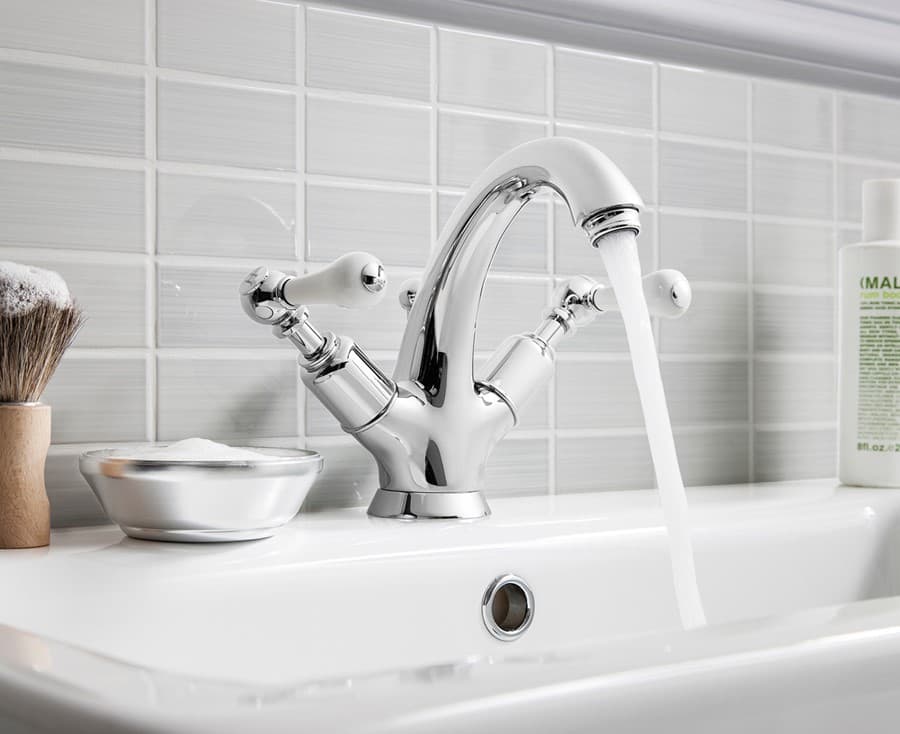
The pictured supplier example is Belgravia Lever Basin Monobloc. Use its exact specification when comparing options; the image does not confirm stock, showroom display availability or suitability for your room.
Sources & further reading
Prepared with AI assistance from the linked sources and Elegant Haven’s published service information. This guide helps you prepare decisions; product suitability and installation details need confirmation for your own room. It is not a record of a completed Elegant Haven installation or an expert sign-off.